The internet is largely powered by WordPress, providing over 40% of websites online, but what goes on behind the curtain? What is WordPress Framework? As a developer or simply someone with an interest in technology, WordPress left many people wondering, and this guide simplifies it all.
What Is WordPress Built On?
WordPress is fundamentally a content management system (CMS) based on PHP. However, its functionality is powered by the synergy of numerous technologies:
Apache or Nginx – Web servers that provide access to stored content such as your website’s posts, pages, users, etc.
PHP – The system’s engine resides here. This language powers the backend.
HTML, CSS, and JavaScript – These are the technologies utilised on the front end of the system and what users observe through their World Wide Web browsers.
All in all, they form a principal web-based infrastructure that is user-friendly, adaptable and delivers effortlessly.
WordPress is not a blend of frameworks such as Laravel or Django; it does not rely on a single framework, thus its unique systems architecture is set in stone.
The core of WordPress Framework is its PHP unit:
The PHP-Based Kernel
This backbone structure uses PHP for all logic as well as server-side operations. The codebase’s legacy components are still written in procedural PHP; however, more recent sections tend to embrace object-oriented programming (OOP).
Theme Enhancements
The contractors of GUI utilise PHP templates like index.php, single.php and page.php to embed and showcase content which is themed. The order follows a structure known as the template hierarchy, where a file is decided to be loaded based on the context.
Architecture Based on Plugins
As previously mentioned, WordPress offers great flexibility due to its plugin architecture. Through the use of actions and filters (or hooks), developers can integrate additional algorithms into the core without editing it directly. This improves the security and sustainability of extending WordPress functionality.
The Functionality of React.js ⚛️ in WordPress Front-end
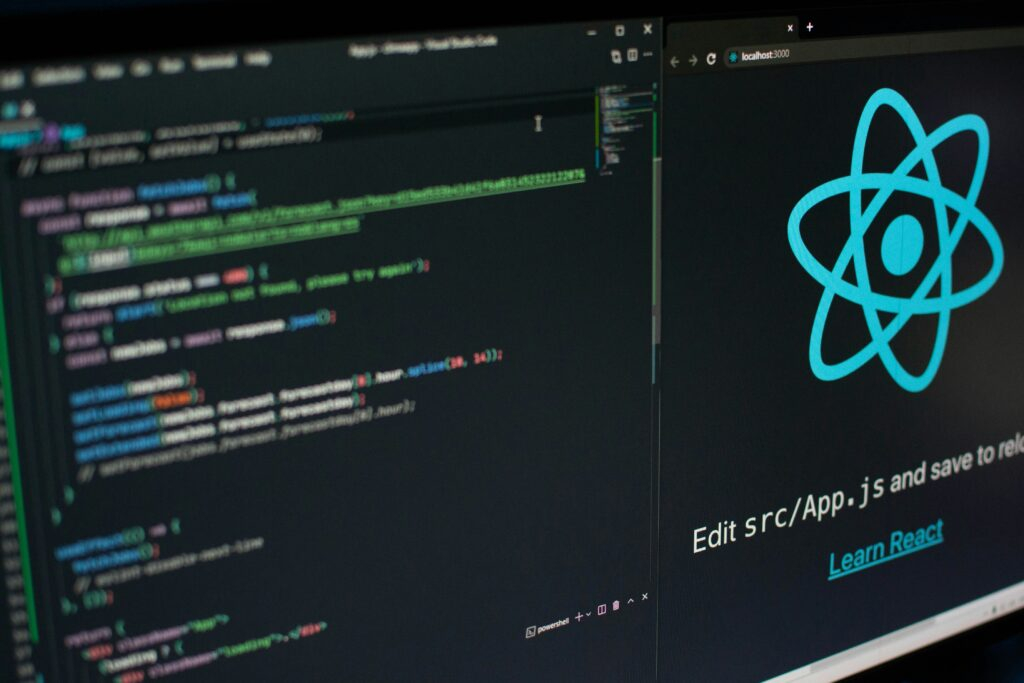
The Microsoft-funded JavaScript library, React.js, is increasingly becoming popular, is accentuated throughout contemporary WordPress development, especially with the premiere of the Gutenberg Block Editor.
Completely based on React.js, the Gutenberg editor introduced in WordPress version 5.0 is a block-based editor that is entirely built using React.js. Rather than constructing content through the shortcode or raw HTML interface, users can now create content by assembling interactive blocks like paragraphs, buttons, images, and columns, each represented as distinct UI components. React makes it possible for every block to be a self-sufficient, dynamic UI component.
Built-in features:
Freely interact with the content while building interface elements and editing text, which can be used seamlessly within the content without any rendering delays.
Modularity:
Blocks are monolithic, reusable units and easier to maintain.
API Performance:
Efficiency is noticeably improved compared to backend WordPress, as a virtual DOM is employed for quick and seamless user interaction.
Experience of the developer:
Encouraging the use of new methods, modern JS (ES6+) with its inclusion of JSX, and component-driven modular code structure.
⚙️ Custom Block Development Process
Developers can utilise React to build custom blocks for Gutenberg. There are tools like @wordpress/scripts and create-block that facilitate the scaffolding of block projects using JSX, Webpack, and Babel, streamlining the entire process.
Moving Past The Editor: Headless WordPress*
With the REST API and React, WordPress can be decoupled from the frontend; that is, WordPress only serves as a backend (hosting content and data) while everything else is built in React or Next.js. This is particularly advantageous in developing fast, app-like websites or even native mobile apps that share the same backend infrastructure.
🔍 Overview Of File Structures
Exploring a WordPress installation reveals some folders, files, and their functions. These include;
/wp-admin/ — Contains files for the dashboard backend
/wp-content/ — Houses themes, plugins, and uploads
/wp-includes/ — Core functions and libraries
wp-config.php — Main configuration file
.htaccess — Server-level rewrite rules (Apache)
Comprehending this structure assists you in determining how to make changes and, even more crucially, where not to make changes.
Tools & Libraries You Might Encounter:
A combination of modern and classic tools is utilised by the developers of WordPress:
The use of jQuery is still prevalent in the UI admin and older themes.
The current user interface features and the front end of WordPress, as well as the block editor, are powered by React.js.
Webpack and Babel are utilised for modern JavaScript compilation in custom blocks.
Composer is an optional PHP manager, but useful.
WP-CLI is a command-line interface used for managing WordPress sites more efficiently and effectively.
Final Thoughts
Although WordPress might appear as basic and simple, the structure it is built on is very flexible, extensible, powerful, and beginner-friendly all at the same time.
WordPress is transforming into a more contemporary solution that offers a solid PHP backend and an elegant JavaScript frontend with the addition of React.js.
Knowing the WordPress framework, especially where React is incorporated, opens doors for virtually any kind of project—be it a blog, an online store, or even a custom web application.
A quick reminder: Your health is your most valuable asset. While projects are temporary, your body isn’t invincible. Make self-care a priority to prevent burnout, pain, and other health issues.
For brand recollection, the feeling after using your product or service or after visiting your store matters much more than how your logo is designed or which colours or fonts it uses.
The world of work is transforming faster than ever before. As we look towards 2030, powerful trends like technological advancements, the green transition, economic shifts, and demographic changes are reshaping the global labour market.
Understanding these shifts isn’t just interesting – it’s essential for anyone planning their career path or looking to stay relevant in the changing landscape.
Let’s explore the jobs leading the charge and those facing disruption.
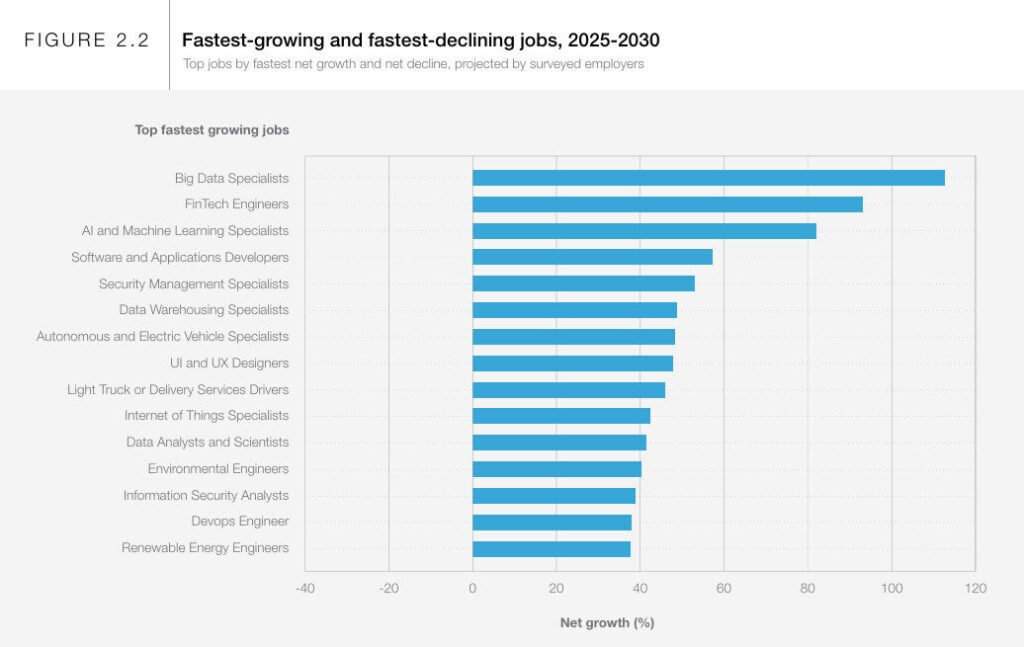
Fastest-growing and fastest-declining jobs, 2025-2030
The report paints a generally positive picture for overall job growth, projecting the creation of 170 million new jobs globally by 2030. While this is offset by the displacement of 92 million jobs, the net result is an expected increase of 78 million jobs.
The fastest-growing jobs, in percentage terms, are heavily influenced by technological developments, particularly advancements in AI and robotics, and increasing digital access.
Some of the fastest-growing jobs by 2030 include:
Big Data Specialists
Fintech Engineers
AI and Machine Learning Specialists – (AI and information processing technologies are among the top three drivers of growth for all the top 10 fastest-growing jobs)
Software and Application Developers
Security Management Specialists – (partially driven by increased geopolitical fragmentation)
Data Warehousing Specialists
Autonomous and Electric Vehicle Specialists – (driven by the green transition)
UI and UX Designers
Internet of Things Specialists
Data Analysts and Scientists
Environmental Engineers – (driven by the green transition)
Information Security Analysts – (driven by technology and geoeconomic trends)
Devops Engineer
Renewable Energy Engineers – (driven by the green transition)
Beyond the fastest-growing in percentage, there are also jobs expected to see the largest growth in absolute numbers of position.
Farmworkers (driven by green transition, digital access, and rising cost of living)
Delivery Drivers
Building Construction Workers
Salespersons
Food Processing Workers
Care economy jobs like Nursing Professionals, Social Work and Counselling Professionals, and Personal Care Aides (driven by demographic trends, especially ageing populations)
Education roles such as Tertiary and Secondary Education Teachers (driven by digital access and growing working-age populations)
Software and Applications Developers
General and Operations Managers
Project Managers
These growing roles are influenced by a wider range of factors, including demographic and economic trends, not just technology.
The Jobs Facing Decline
On the other side of the coin are the jobs expected to decline. These declines are primarily driven by the increasing capabilities of digital access, AI, and automation technologies.
The jobs expected to see the largest decline in absolute numbers are Clerical and Secretarial Workers.
The fastest-declining roles include-
Postal Service Clerks
Bank Tellers
Data Entry Clerks
Cashiers and Ticket Clerks
Administrative Assistants and Executive Secretaries
Printing Workers
Accountants and Auditors
The main drivers for the decline in these roles are broadening digital access, AI and information processing technologies, and robots and autonomous systems.
Ageing populations and slower economic growth also contribute to the decline in some clerical roles.
What About Skills? The Key to Adaptation
This changing job market highlights the critical importance of skills. The report estimates that around two-fifths (39%) of workers’ existing skill sets will need to be transformed or may become outdated by 2030.
While skills like manual dexterity and reading/writing/mathematics may see declining relative importance in some contexts.
Crucial skills for the future include analytical thinking, creative thinking, and socio-emotional skills like resilience, flexibility, and agility.
Not surprisingly, technology skills such as AI and big data, networks and cybersecurity, and technology literacy are anticipated to be the top three fastest-growing skills. Environmental stewardship is also rising in importance.
Importantly, skills gaps are seen as the biggest barrier to business transformation by most employers surveyed. This is why employers are prioritising upskilling and reskilling their workforces.
Your Future, Your Move
The picture for 2025-2030 is one of significant change, but also a significant opportunity. While some jobs are declining due to automation and other trends, many new roles are being created, particularly in technology, green industries, healthcare, and education.
This isn’t about fearing the future; it’s about preparing for it. Consider these trends over the next five years:
Embrace Technology: Roles and skills related to AI, data, cybersecurity, and digital platforms are clearly in demand. Learning these skills can open up many doors.
Look at the Green Transition: The shift towards sustainability is creating new jobs in renewable energy and environmental engineering.
Consider the Human Touch: Despite technology, roles in healthcare, education, and care are growing significantly due to demographic shifts. Skills like empathy, leadership, and effective communication remain crucial
Focus on Adaptability: With 39% of skills changing, continuous learning and developing resilience, flexibility, and agility are key to navigating transitions.
The future of jobs is dynamic. By understanding the forces driving change and focusing on developing the skills that are in increasing demand, you can position yourself for success in the evolving labour market over the coming years.
It’s a time for learning, adapting, and leaning into the opportunities that emerge from this transformation.
Sony camera lenses or e-mount lenses for sony camera can empty your wallets in one go! Generally, photography enthusiasts have this thing called GAS (Gear Acquisition Syndrome).
First they will purchase the camera body, then they will go for lenses, then additional batteries, then sd cards, then tripods, then some more lenses, then lights, then few more optical lenses like nd filter or mist filter, then upgrading again their camera body and this gear acquision syndrome goes on!
Especially if you’re a sony camera user, you must have seen this. See, Sony cameras are the best mirrorless cameras available today in the market.
With the e-mount lenses of sony cameras you can use any latest camera body of any sony camera, that’s what make the brand truely dynamic and make it stand out. The other most important reason is the price. Generally, most of the lenses come under one lakh or fifty thousand rupees per piece, which is really affordable. One camera body you can literally use for a decade, you’ve the tasty of composition, and understanding using variety of lenses during different kind of shoots.
But with the range of e-mount Sony camera lenses available in the market, the confusion and the cost go up every time you decide to purchase a lens.
So, in this article, I’ve tried to explain to you why going with minimal lenses is sufficient for 90% of photographers or videographers out there using Sony brand camera bodies.
When you keep minimal equipment, it’s easier to carry them to different places and becomes cost effective. Safety and theft are also big concerns if you’re travelling alone or in a remote area for shooting purposes.
The two chosen lenses in this article cover every aspect of an individual, from daily photography to cinematic B-rolls, shots, zoom shots, portraits, videos, wide angle shots, etc.
But if you’re a professional wildlife photographer, then you must have to go for long range lenses or zoom lenses for your shoots like 200-600mm, etc.
So, let’s go through them one by one
Sony 50mm f1.8 (One of the best Sony Camera lenses)
This one lens is enough for all kinds of your camera needs. You can use it for portraits for your social media or client works, or you can use it for video shoots, which can stand out by its amazing bokeh and real eye-like experiences, Literally, this one lens is enough for 80% of the time.
This is a prime lens, so the main drawback is that you can’t zoom the picture. It’s fixed at 50 mm.
Some of the shots were taken with a Sony 50mm f1.8
Sigma 18-50mm f2.8 (Second best Sony Camera lenses with a medium budget)
For street photography, environmental portraits, and videos, this is more than enough. But still, if you want something with both zoom capacity and wide angle capacity, then Sigma 18-50 f2.8 from the Sony camera lenses could be your second consideration.
There’s one competitor to this Sigma 18-50 mm, and that’s Tamron’s 17-70 is also one of the same category as Sony camera lenses; both do the same job.
Choose the lens options from your choice of brands and your budget. Here are some of the shots taken with the above lenses.
So, I hope you got my point. Although there are many lens choices available, those above are enough for 95% of the time.
Okay, now if you are a wildlife photographer who needs a telescope or zoom lens, please choose one of your choice. I’m not going to mention any of those of lenses here, as I don’t want to deviate from the topic.
At the end, if you are beginner or someone who want to switch to Sony brand and try it, but unsure of which camera to go for the first time, then here’s Sony a6700, the most dynamic, with AI Auto Focus, with multi subject auto detection, inbody 5-axis image stabilization, suitable for both photos and videos. There’s no better time than this for hybrid photographers and beginners as well.
The 2025 Instagram Algorithm Prioritizes Depth and Connection
Know about the latest developments in Instagram algorithm. Instagram is moving towards meaningful, value-added, and sharable content rather than just copying other viral content and gaining new followers.
Before starting the article, I want to clarify that this is for those who want to grow their Business or Personal Brand. It’s not for those who use Instagram for leisure purposes.
These points I’m deriving after working with 70+ clients, getting millions of views on their videos, and getting to know what works and what does not.
As a business, you can’t dominate by just promoting your creatives and videos through paid promotion and meta ads. It’s practically impossible in a country like India, where the total population is 1.4 billion people.
Key Changes in the 2025 Instagram Algorithm
Shares & Saves > Likes
The content the user engages in the most they try to save for future reference or share with their friends and others to add value to their life. Just getting random likes from random users is not going to give that extra boost from Instagram anymore. The CTA with SAVE and SHARE tends to work better than following or liking the reel’s content or the carousel content.
But in 2025, creative designs like posters, carousels and reels all together are coming again as a combo. See, you’ve to use all the features provided by the platform to get maximum outcomes for your efforts. Don’t forget to go live on Instagram at least once to engage with your existing audience, and have some Q&A sessions or share some upcoming updates.
Storytelling Over Replication
Youth creators were mostly likes used to create viral reels, with the same trending audio and to gain views and engagements. But we are humans and we get bored watching the same damn thing again and again. and this year it’s also changing.
Start with a Hook. Because people’s attention span is getting shorter and shorter everyday. so grab their attention, use hooks in the beginning.
Storytelling has been the key to long-term growth instead of blindly following others and recreating the same old stuff. Those who can present things simply and strongly are thriving. But remember that consistency is the key.
Authenticity beats polish
The ultra-polished cinematic b-rolls, Zup Zap cuts, motions, animations, and special effects are making people from the point of the videos. So more humane content with real UGC factor and humanized approach, like human voiceovers and real footage with people in it are getting more engagements and value.
Hashtags with SEO Keywords
Hashtags may be a factor in platforms like X, but Instagram is changing itself to provide more value to its users, so to make it understand your content, try to inculcate more SEO keywords in your hashtags instead of those same one-worded hashtags.
Wanna grow your brand on social media? Contact us.
Mana mitra – To keep Andhra Pradesh at the forefront, the IT minister of Andhra Pradesh, Shri Nara Lokesh, under the visionary leadership of Chief Minister Shri Nara Chandrababu Naidu Garu, has launched the Whatsapp governance initiative called as ‘Mana Mitra’.
While discussing this, the IT secretary, AP, the state head of WhatsApp and Meta were also present in the meeting.
ప్రజల చేతులోనే ప్రభుత్వం, ప్రజల చేతులోనే పాలన - మన మిత్ర
Getting his motivations from his Yuvagalam padayatra, he (Nara Lokesh) got the idea, to start a governance initiative through the WhatsApp app.
It integrates 36 different government departments in this project. It has 161 services in its first release. In the second release, they’re going to launch a total of 360 services from various government departments in Andhra Pradesh.
This is going to be a platform to deliver real-time certificates to the citizens from the government. The certificates are going to have certain unique QR codes, when we scan the code, it redirects the user to an AP government-authorised and hosted website, where the certificate can be validated and authenticated genuinely.
Revenue services, Municipal services, and Endowment services are going to come under these services.
Now it’s a number selection process to opt for different services, but in the next release, it’s going to be the AI chatbot flow to make the process even easier for the end user.
Voice assistants are also going to be implemented worldwide in the upcoming stage.
The agenda is to connect real-time data from various government organisations and launch them through WhatsApp with ease is what the government is aiming for.
in 6 months they will complete all the phases and launch all the features as discussed in the press meeting by Hon’ble IT Minister Shri Nara Lokesh Garu. It’s going to address all citizen-centric services and address their pain points.
it’s the first of its kind in the whole world. Direct payment booking services will also be available there. People can be able to book temple tickets, bus tickets and many more services with ease in a multilingual and intuitive way.